
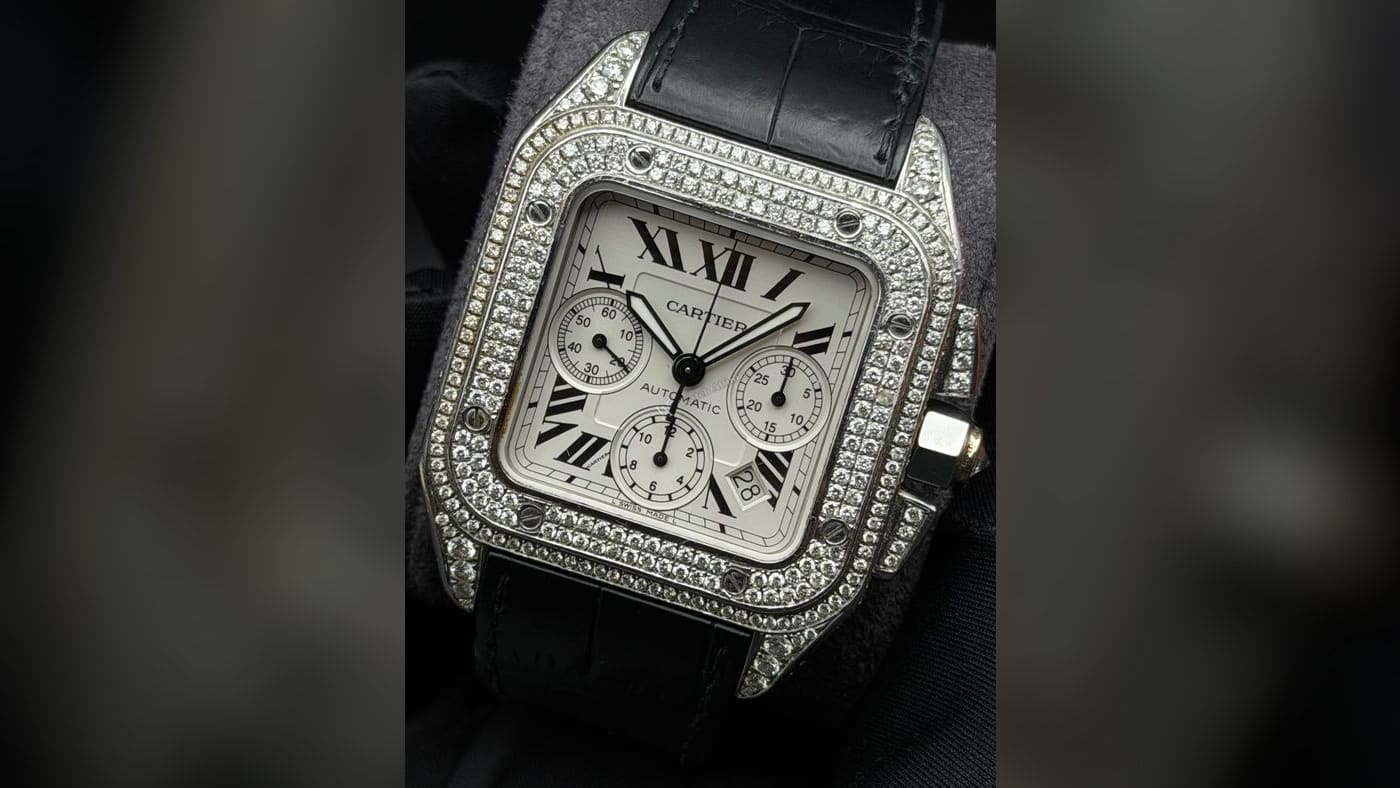
The Cartier Santos has a claim almost no other watch can make: it is arguably the first purpose-built men’s wristwatch. In 1904, Louis Cartier designed it for his friend, the aviator Alberto Santos-Dumont, who needed to read the time in flight without fumbling for a pocket watch. More than a century later, the square case, exposed screws, and integrated bracelet are still instantly recognizable — and the Santos has become one of the most requested watches we see at Watch Affinity.
This guide covers what actually matters when you’re buying one: the current lineup, the sizes, the movement, what to inspect on a pre-owned example, and what you should realistically expect to pay in 2026.
The Modern Santos Lineup
Cartier fully redesigned the Santos in 2018, and that generation — the Santos de Cartier — is what most buyers are shopping for today. It introduced two features that genuinely changed the ownership experience: QuickSwitch, which lets you swap the bracelet for a strap with no tools, and SmartLink, which lets you resize the bracelet yourself. Inside is Cartier’s in-house automatic caliber 1847 MC — reliable, anti-magnetic, with roughly a 40-hour reserve.
The core sizes are:
- Large (39.8mm × 47.5mm): the default choice for most men and the most liquid on the resale market.
- Medium (35.1mm × 41.9mm): increasingly popular as a unisex size; wears smaller and dressier.
- Small: positioned as a ladies’ size, usually quartz.
Beyond the standard model you’ll find the Santos Chronograph, the openworked Santos Skeleton, and the slimmer Santos-Dumont (a thinner, often hand-wound or quartz dress interpretation — don’t confuse the two). Materials run from stainless steel to two-tone (steel and yellow gold), solid yellow gold, and rose gold, with a large ADLC-coated black option as well.
What It Costs in 2026
These are realistic pre-owned ranges we see in the current market; condition, box/papers, and year move them:
- Santos Medium, steel: roughly $5,500–$7,000.
- Santos Large, steel: roughly $6,500–$8,500.
- Santos two-tone (steel/gold): roughly $8,000–$11,500.
- Santos Chronograph, steel: roughly $8,500–$11,000.
- Solid gold models: vary widely with gold weight and configuration — typically well into five figures.
The Santos has benefited from the broader collector appetite for integrated-bracelet steel sports watches. It doesn’t swing like a hyped Rolex sports reference, but it holds value steadily, and clean full-set examples are consistently easy to sell.
Buying Pre-Owned: What to Check
The Santos is generally a safe buy, but a few things separate a good example from a compromised one:
- QuickSwitch bracelet + any extra strap. A full set often includes an additional leather strap and the tool/deployant. Missing accessories aren’t deal-breakers but should be reflected in the price.
- The exposed screws. The signature case and bezel screws should be crisp, not chewed up by an amateur pushing a bracelet resize.
- Bracelet stretch and link count. Confirm enough SmartLink links are present for your wrist — sourcing extra links after the fact can be slow and costly.
- Box, papers, and service history. They add real value and speed up any future resale.
- Authenticity. Cartier is among the more heavily counterfeited brands. Movement finishing, engraving depth, dial printing, and the cabochon crown all tell the story — which is exactly why buying from a dealer who authenticates in-house matters.
Santos or Tank?
These are the two Cartier icons buyers cross-shop most. The short version: the Tank is the definitive flat, elegant dress watch; the Santos is sportier and more robust, with a bracelet and a case built for daily wear. If you want one Cartier that handles a suit and a weekend equally, the steel Santos Large is the most versatile answer.
The Bottom Line
The Santos is a rare thing — a genuinely historic design that’s also a practical everyday automatic with a tool-free bracelet. Buy a clean example with its accessories, from a seller who authenticates, and you’re getting one of the most wearable luxury watches on the market. If you’re selling or trading a Santos, we make market-accurate same-day offers.
Looking for a Cartier Santos?
We carry authenticated Cartier and make honest same-day offers if you’re selling or trading. Every watch is verified and guaranteed.
Browse Our Inventory Sell or Trade YoursFrequently Asked Questions
How much does a Cartier Santos cost in 2026? Pre-owned, a steel Santos Medium runs roughly $5,500–$7,000 and a steel Large about $6,500–$8,500. Two-tone and chronograph models run $8,000–$11,500, and solid gold goes well into five figures. Condition and a full set (box and papers) move the number.
What is the difference between the Santos and the Santos-Dumont? The Santos de Cartier is the modern automatic with an integrated bracelet, QuickSwitch, and SmartLink. The Santos-Dumont is a slimmer, dressier interpretation, usually hand-wound or quartz, on a strap. They share the heritage but are different watches.
Does the Cartier Santos hold its value? Yes — steadily. It doesn’t spike like hyped Rolex sports models, but strong demand for integrated-bracelet steel watches keeps clean full-set Santos examples easy to sell and consistent in value.
Which Santos size should I buy? The Large (39.8mm) is the most versatile and liquid choice for most men. The Medium (35.1mm) has become a popular unisex size and wears dressier. Try both if you can — the square case wears larger than the numbers suggest.